
The Case for Gratitude — Even in Grief
(And why choosing it, even in tiny doses, can shift your heart more than you think)
I’ll be honest… gratitude feels complicated when you’re grieving.
When you’ve lost a child or a parent or you're going through a hard time, people throw around words like hope and healing as if they aren’t asking your heart to do the hardest thing it’s ever done.
And then, someone mentions gratitude.
It almost feels offensive, doesn’t it?
Like you’re being told to “look on the bright side” when the brightest thing in your life is now gone.
But what I’ve learned—both in my own grief and in walking alongside so many other women—is this:
Gratitude is not a betrayal of your pain.
It’s a lifeline within it.
And choosing it (even in the smallest, quietest way) doesn’t deny your loss.
It helps you carry it.
So today, I want to make the case for gratitude in grief—not as a bypass, not as a platitude, but as one of the most powerful emotional, spiritual, and neurological tools God has given us.
Why Gratitude Matters (Especially When Your Heart Is Broken)
1. Gratitude operates at a higher emotional frequency than grief.
That statement probably had you saying to yourself, "What the heck does that mean!" Well.....
Grief sits in the heavy, low-energy emotional states—sadness, exhaustion, hopelessness, guilt. These aren’t “bad.” They’re human. They’re expected. They’re part of love.
But gratitude?
Gratitude lives on a completely different frequency—one where hope, joy, peace, and connection reside.
Not the loud, bubbly kind.
The quiet kind.
The kind that feels like a flicker of light in a dark room.
And here’s the miracle:
Two emotional frequencies can coexist, but the higher one can begin to lift the lower.
Not erase it… but lift it.
This is one reason Scripture says:
“In everything give thanks…” — 1 Thessalonians 5:18
Not because everything is good.
But because thankfulness opens a spiritual doorway to God’s presence, comfort, and strength.
2. Gratitude literally changes your brain chemistry.
Say what!? Yep ....
Studies show that practicing gratitude activates two major areas of the brain:
The prefrontal cortex (responsible for emotional regulation)
The anterior cingulate cortex (linked to empathy and connection)
When these areas “light up,” several things happen:
Stress hormones drop
Your nervous system calms
Your perspective widens
Hope becomes more accessible
Emotional numbness starts to thaw
You feel more connected. Both to God and to others.
Researchers at UCLA found that naming something you’re grateful for decreases activity in the amygdala which is your fear and stress center.
Translation:
Gratitude interrupts the survival response that grief often traps you in.
It’s not magic. It’s biology.
And God designed it that way on purpose.
3. Gratitude strengthens your faith instead of replacing your sorrow.
One of the biggest fears grievers often confess is this:
“If I start healing, it means I’m forgetting.”
“If I feel happy, it means I didn’t love them enough.” (I've been there on this one!)
“If I start moving forward, I’m leaving them behind.”
But here is the truth, none of those fears is true.
For God has not given us a spirit of fear, but of power, love, and a sound mind. (2 Tim 1:7). And He gave us gratitude.
Gratitude doesn’t push your loved one out of your heart.
It helps you carry their memory with less pain and more love.
Gratitude reconnects you with God’s nearness when your faith feels shaken.
It reminds you that joy and grief aren’t opposites.
They are companions.
Scripture backs this up:
“The joy of the Lord is your strength.” — Nehemiah 8:10
Joy isn’t the absence of sorrow.
Joy is the strength within sorrow.
4. Gratitude is a choice… not a feeling.
Most grieving women tell me:
“I don’t feel grateful for anything right now.”
Of course you don’t.
You’re not supposed to feel your way into gratitude.
You choose your way into it.
And that may sound easier said than done. So sometimes the most honest gratitude sounds like:
“God, I’m thankful for breath in my lungs today.”
“I’m grateful I made it out of bed.”
“Thank You for the sunlight coming through the window.”
“Thank You that You haven’t let go of me.” (I relied on this one a lot and God's promise that He would never leave me or forsake me)
Small choices can shift emotional trajectories.
Tiny gratitude → calm nervous system
Calm nervous system → clearer thoughts
Clearer thoughts → a little more hope
More hope → the strength to keep going
It’s a slow climb, but it’s real.
How to Practice Gratitude When You’re Grieving
Practicing gratitude, or even choosing to try and practice gratitude, can seem to be too much. But, here are some simple, gentle, doable—even on your hardest days.
1. One-Sentence Gratitude
At the end of the day, write just one sentence:
“Today, I’m grateful for __________.”
No pressure. No forcing. One sentence is enough.
It may just be that the sun came up that morning, or you made it out of bed, or Aunt Sally called, or you felt God's calming presence. It doesn't have to be big, just recognized.
2. Gratitude Paired With Grief
This is powerful. Try saying:
“I’m grieving __________________,
and I’m grateful __________________.”
What does this look like? Here are some examples:
“I’m grieving the quiet house… and I’m grateful You still sit with me in it.”
“I’m grieving that she’s not here… and I’m grateful she shaped who I am.”
"I'm grieving you won't be here for Thanksgiving ... and I'm grateful that you are still in my heart."
You may be tempted to replace it with the word "but": "I'm grieving, but I'm grateful."
Don't do it because the word "and" is very important in this exercise and has a particular effect on your brain. It tells your mind that both frequencies, grief and gratitude, can exist at the same time, which is realistic.
If you replace "and" with "but", that one small switch tells your brain that the the second half is more important (gratitude), the first half must take a backseat (your feelings of grief), and that gratitude should override or cancel grief. Your mind interprets “but” as: “Only one of these is acceptable.”
This can make you feel guilty, pressured to be okay, like grief is the "wrong" emotion (which its not), or like gratitude is supposed to fix everything
Instead, “and” feels like permission.
It says:
“You’re allowed to grieve.
You’re allowed to find gratitude.
You’re allowed to hold both.”
This mirrors how Jesus held truth + compassion together.
He never told hurting people, “But don’t feel that way…”
He met them where they were and walked them forward with love.
“And” does the same. And, as we saw earlier, the higher frequency begins to soften the lower.
3. Create a ‘Thank You, God’ List
Not a list of blessings.
A list of moments where you felt held.
A friend who texted.
A memory that made you smile.
A moment you felt peace for even 10 seconds.
This becomes proof you can come back to on the days you doubt God’s nearness.
4. Speak Gratitude Out Loud
The spoken word carries power.
When you say something out loud, your brain encodes it differently.
Even whispering,
“Thank You, God,”
can shift your internal world.
5. Gratitude for the Person You Lost
This one takes time, but it brings deep healing.
Write:
“I’m grateful I got to love you.”
Not “I’m grateful you’re gone.”
Not “I’m okay with this.”
Just…
“I’m grateful our lives touched.”
"I'm grateful you were part of my life."
"I'm grateful you made me a mother."
"I'm grateful you were my mother."
This honors them without denying your grief.
The Real Reason Gratitude Works in Grief
Because gratitude invites God into the pain.
It reminds you you’re not walking through this valley alone.
It reopens tiny cracks in your heart where light can get in.
It reconnects you to who you’re becoming—not just what you’ve lost.
And over time, gratitude becomes a steady companion…
A gentle guide…
A soft place to land…
A stepping stone toward rebuilding your life with meaning, faith, and purpose again.
So this Thanksgiving season, even in your grief, even if you don't feel grateful, choose gratitude. Even one small tiny moment of gratitude can change your perspective, calm your mind, and ease your heart.
If you want a safe, faith-rooted place to keep doing this work…
✨ Come join my Facebook community, Grief Support & Healing After Loss, for Christian women navigating grief.
This is where we breathe, heal, and find our footing together.
✨ Or download my free resource:
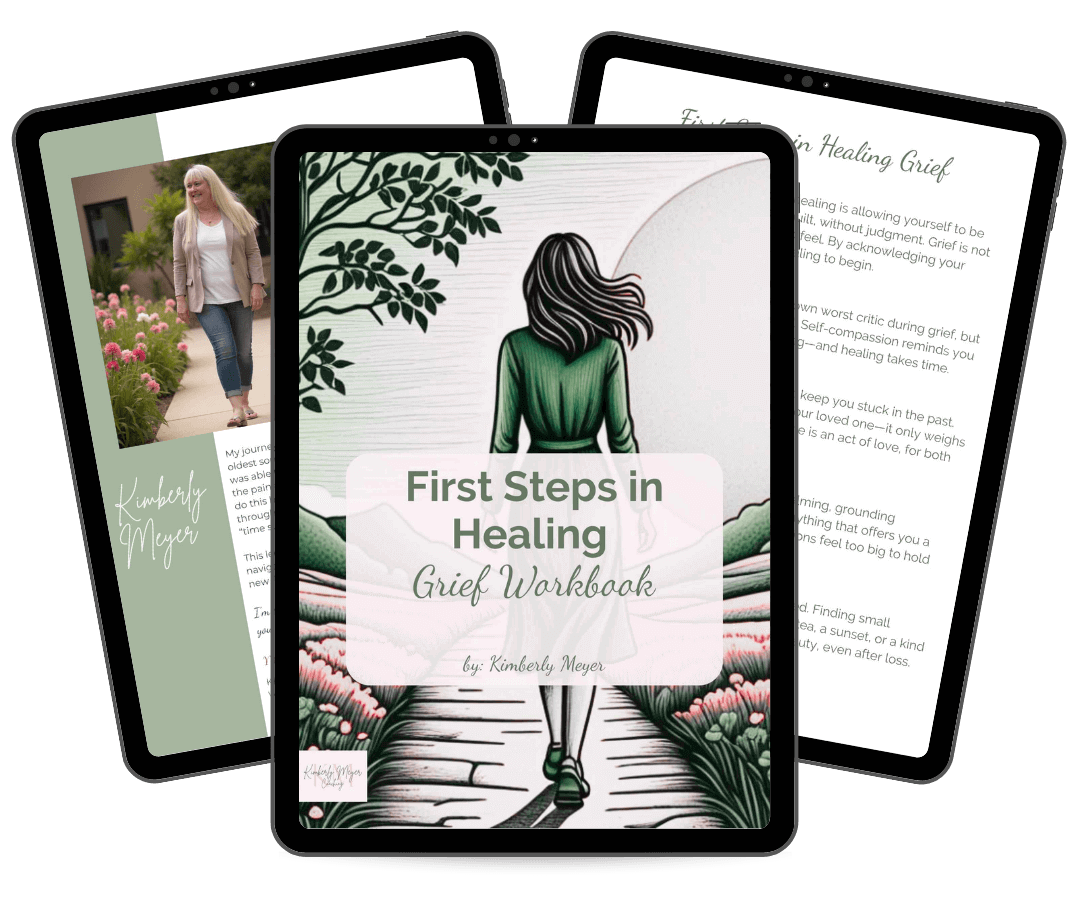
The First Steps in Healing Grief Workbook
It’s gentle, faith-based, and gives you simple emotional tools your heart can actually handle right now.
✨ And if the holidays are especially tender this year…
Grab the replay + workbook from my Holiday Joy, Rewritten Grief Workshop.
You don’t have to white-knuckle your way through this season.
You deserve support.
If you need space to breathe, I’m here.
If you’re ready for a gentle nudge forward, I’m here for that too.
You’re not broken.
You’re not failing at grief.
You’re just carrying a love that changed everything.
And gratitude can help you carry it with a little more light.